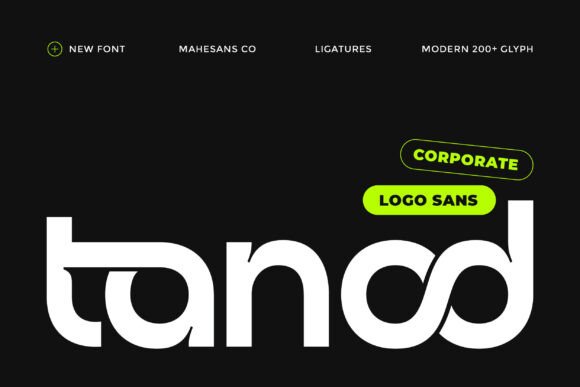
Tanod: The Modern Sans Serif for Logos That Command Attention
There's a particular kind of frustration that comes with scrolling through hundreds of typefaces, trying to find one that looks polished without feeling sterile. You want something clean—something that reads as professional—but you also need personality. A font that whispers confidence rather than shouting for attention. That's the gap Tanod was built to fill.
Most sans serif fonts fall into one of two camps. They're either so neutral they disappear into the background, or they're so stylized they age poorly. Tanod takes a different approach. Its geometric foundation gives it structure and balance, while subtle quirks in the letterforms—a slightly unusual curve here, a refined terminal there—prevent it from feeling generic. The result is a typeface that looks expensive without trying too hard, which is exactly what strong branding demands.
Why "Expensive" Matters More Than "Fancy"
When people talk about premium fonts, they often mean ornate or decorative. But real visual sophistication in branding rarely comes from flourishes. It comes from restraint, precision, and intentional design choices. Think about the logos you associate with high-end brands—many of them use relatively simple typography. The difference between a five-dollar logo and a five-thousand-dollar one often comes down to the font's quality at a structural level: how the curves are drawn, how spacing feels across a word, how consistent the weight distribution is from letter to letter.
Tanod was designed with this philosophy in mind. Every glyph has been carefully crafted so that when you assemble letters into a word or phrase, the rhythm feels natural. There are no awkward gaps, no uneven baselines, no sudden shifts in visual weight. That consistency is what gives a logotype its sense of authority. It's the kind of detail most people can't articulate but everyone instinctively notices.
Practical Applications Beyond the Logo
A strong logo font earns its value by working across an entire brand ecosystem. Tanod's clean geometric structure makes it surprisingly versatile, extending well beyond a single wordmark.
For packaging design, its high legibility at small sizes ensures product names and descriptions stay crisp on shelf labels, boxes, and bottles. For social media graphics, its sharp letterforms hold up beautifully at thumbnail scale—something many fonts struggle with. On websites and blogs, Tanod brings a modern, editorial quality to headlines without sacrificing readability in navigation or button text.
Print applications benefit equally. Whether you're designing business cards, posters, event invitations, or marketing collateral, the font maintains its character across different sizes and substrates. It even works well for merchandise—think branded apparel, tote bags, or stickers—where a logo needs to be instantly recognizable at a glance.
For editorial layouts and digital products like e-books, course materials, or downloadable templates, Tanod offers that rare combination of personality and neutrality. It adds visual interest to headings and pull quotes without competing with body copy or photography.
Matching Typography to Your Project Goals
Choosing a font isn't just about aesthetics—it's about communication. Before selecting any typeface, including Tanod, it's worth asking yourself a few practical questions:
- What's the primary medium? A font that dominates on a billboard might feel heavy on a mobile screen. Tanod's geometric clarity translates well across both, but knowing your primary use case helps you choose the right style weight.
- What emotion should the brand convey? Modern and trustworthy? Sleek and innovative? Approachable but serious? Tanod leans toward confident professionalism with a contemporary edge, making it well-suited for tech startups, consultancies, creative agencies, and modern retail brands.
- How will it pair with other fonts? No typeface works in isolation. Consider what you'll use for body text, captions, or supporting elements. A simple serif or even a clean handwritten font can complement Tanod's structured geometry, creating visual contrast that keeps layouts dynamic.
Testing font pairings before committing is essential. Set your headline in Tanod, then try several body text options beneath it. Pay attention to how the x-heights relate, whether the overall tone feels cohesive, and whether the hierarchy is immediately clear. Good typography should guide the reader's eye effortlessly.
Readability Is Non-Negotiable
One of the most common mistakes in branding is choosing a font that looks beautiful in a logo mockup but falls apart in real-world use. A restaurant menu, a mobile app interface, a trade show banner—each context demands different performance from a typeface.
Tanod addresses this by maintaining clarity across its full range of sizes. The letter spacing is generous enough to prevent crowding at small dimensions, while the open counters and distinct character shapes ensure that individual letters remain recognizable even in challenging conditions—low resolution, poor lighting, or fast scanning. This isn't accidental. It's the result of deliberate design decisions that prioritize function alongside form.
When evaluating any font for a branding project, print a few test samples. Hold them at arm's length. View them on a phone screen. Shrink them down to favicon size. If the text still reads clearly, you've found a typeface that can genuinely serve your brand across touchpoints.
Understanding What's Included
A premium font's value often lies in the breadth of its family. Tanod typically ships with multiple weights and styles, giving you flexibility to create hierarchy and emphasis within a single type system. Lighter weights work beautifully for subheadings and supporting text, while bolder cuts anchor logos and hero sections with visual punch.
Before purchasing any commercial font, review what's included in the package. Check for:
- Weight range—from thin or light through regular, medium, semibold, bold, and beyond
- Italic or oblique styles—useful for emphasis and editorial design
- Extended character sets—including accented characters for multilingual support
- OpenType features—such as ligatures, alternates, or stylistic sets that add typographic refinement
- Licensing terms—ensure the license covers your intended use, whether that's a single client project, multiple commercial products, or enterprise-wide deployment
Commercial licensing is one of those details that's easy to overlook until it becomes a problem. If you're designing for a client, make sure the license covers their use of the final deliverables. If you're creating products for sale—templates, merchandise, digital downloads—verify that the font's license permits embedding or redistribution in those formats.
Building a Brand Identity Around a Single Typeface
Some of the most recognizable brands in the world rely on a single typeface family for nearly everything. There's power in that consistency. When customers see the same typographic voice on your website, your invoices, your social posts, and your product packaging, it creates a unified experience that builds recognition over time.
Tanod's versatility makes it a strong candidate for this kind of single-typeface branding strategy. Its range of weights allows you to establish clear hierarchy—bold for headlines, regular for body copy, light for accents—without introducing a second font that might dilute the visual identity. The geometric structure keeps everything feeling cohesive, even as you move between applications.
That said, even within a one-font system, it's smart to establish clear rules. Define which weight you'll use for primary headings, which for secondary text, and which for calls to action. Document these choices in a simple style guide. It doesn't need to be elaborate—just consistent. That discipline is what separates brands that look professional from brands that look improvised.
A Typeface That Earns Its Place
Fonts are tools. Some are specialized, some are general-purpose, and some—like Tanod—occupy that valuable middle ground where distinctive character meets broad utility. It won't replace every font in your library, nor should it. But for projects where you need a modern sans serif that communicates professionalism without sacrificing individuality, it's a typeface worth serious consideration.
The best way to know if it's right for your next project is simple: test it. Set your brand name in Tanod. Look at it in context—on a mockup, in a layout, at the size you'll actually use it. Does it feel right? Does it say what you need it to say? If the answer is yes, you've found more than a font. You've found a visual voice for your brand.