Shape: A Typeface Built for Brand Clarity
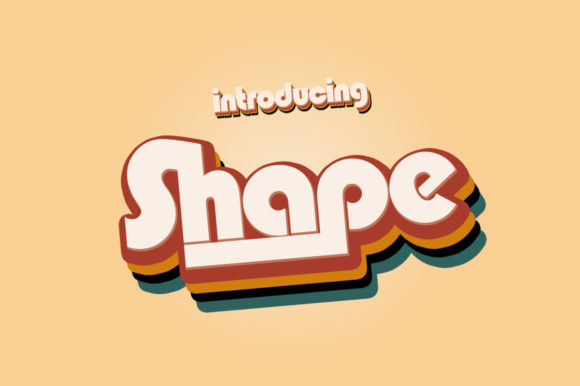
Every brand has a visual voice, and most of the time, that voice starts with typography. You can spend hours perfecting a logo, choosing a color palette, and crafting the perfect tagline, but if the font underneath it all feels generic or poorly spaced, the whole message wobbles. Shape is a typeface designed specifically for that moment—when you need something clean, balanced, and ready to work across dozens of applications without losing its edge.
What makes Shape stand out isn’t just its appearance, but its intention. It’s built for real-world use: company branding, advertising, business cards, invitations, apparel, display text, and anything else where perfectly kerned letterforms matter. If you’ve ever struggled with fonts that look great in a headline but fall apart in a paragraph, or that feel too stiff for social media but too playful for a formal document, Shape sits in that useful middle ground. It’s modern without being trendy, professional without being boring, and versatile enough to carry a project from concept to completion.
Designed for the Way We Actually Use Fonts
Think about how many different places your brand’s typography shows up. It’s on your website, your packaging, your email headers, your Instagram stories, your printed brochures, and maybe even on merchandise like T-shirts or tote bags. Each of those contexts has different demands. A font that works beautifully on a business card might get lost on a billboard. Something that looks sharp in a logo might feel too heavy in body text.
Shape is built to handle that range. Its letterforms are carefully balanced, with consistent stroke widths and thoughtful spacing that hold up whether you’re setting a large headline or a small caption. The kerning—the space between individual characters—is particularly well-handled, which means you spend less time manually adjusting letter pairs and more time focusing on the bigger design picture. For anyone who’s ever wrestled with awkward gaps between a “T” and an “o” or a “V” and an “a,” that kind of built-in precision is a quiet relief.
Where Shape Really Shines: Practical Applications
Let’s talk specifics. If you’re building a brand identity, you need a typeface that feels cohesive across all touchpoints. Shape works well in logo design because its clean lines and balanced proportions make it adaptable to different layouts—stacked, horizontal, with or without a tagline. It doesn’t fight for attention, but it doesn’t disappear either.
For packaging design, readability is key. Customers often glance at products quickly, so your font needs to communicate clearly at a distance and up close. Shape’s legibility holds up in both scenarios, making it a solid choice for labels, boxes, and product inserts. It also pairs well with both serif and sans serif fonts, so you can create hierarchy without visual clutter.
Social media is another area where typography can make or break engagement. A font that’s too ornate might look beautiful on a design mockup but become unreadable on a small phone screen. Shape maintains its clarity in digital formats, which means your Instagram graphics, Facebook ads, and Pinterest pins will look polished without sacrificing accessibility. It’s the kind of font that works just as well in a quote graphic as it does in a promotional banner.
And then there’s print—invitations, posters, editorial layouts, business stationery. Shape’s balanced design gives it a timeless quality that doesn’t feel tied to a specific design trend. That’s useful if you want your materials to look current without feeling dated in a year or two. It’s also a great choice for wedding invitations, event programs, or any project where elegance and readability need to coexist.
Pairing Shape with Other Fonts
One of the most practical skills in design is knowing how to combine typefaces. Shape works well as a primary font for headlines or logos, but it also plays nicely with other styles. If you’re going for a more traditional look, try pairing it with a classic serif for body text. For a modern, minimalist vibe, a clean sans serif can complement its structure. Even script or handwritten fonts can work alongside Shape if you’re careful about contrast—just make sure the pairing doesn’t feel like two fonts competing for the same role.
A good rule of thumb is to use Shape where clarity and impact matter most, and then choose a secondary font that serves a different function. For example, Shape could handle your brand name and key headings, while a more neutral font takes care of longer paragraphs or supporting text. This kind of intentional pairing creates visual rhythm and helps guide the reader’s eye through your design.
What to Consider Before Choosing Shape
Like any design asset, Shape isn’t a one-size-fits-all solution. It’s worth taking a moment to think about your project’s specific needs. If you’re working on a luxury brand that relies heavily on ornate details or hand-lettered flourishes, Shape might feel too restrained. Conversely, if your brand voice is playful, quirky, or highly expressive, you might find it a bit too polished.
That said, its versatility is one of its strongest qualities. It’s a premium font in the sense that it’s been designed with care and attention to detail, but it doesn’t come with the steep learning curve or compatibility issues that some specialized typefaces do. It’s straightforward to use, which is especially helpful if you’re a small business owner or content creator who wears many hats and doesn’t have time to fuss with finicky design tools.
Before committing, test it in context. Set your brand name in Shape, then try it in a mockup for a business card, a website header, or a social media post. See how it feels at different sizes. Check the spacing. Make sure it aligns with the tone you’re trying to convey. Typography is subjective, and what works for one brand might not work for another—so let your project guide the decision.
Licensing and Long-Term Use
If you’re planning to use Shape for commercial projects—whether that’s client work, merchandise, or digital products—make sure you understand the licensing terms. Many fonts come with different licenses depending on how they’ll be used, and it’s worth clarifying upfront whether your license covers print, digital, and merchandise applications. This is especially important if you’re a freelancer or agency creating work for multiple clients, as some licenses are tied to a single user or project.
Investing in a well-kerned, professionally designed font like Shape can save you time and frustration down the road. It reduces the need for manual adjustments, ensures consistency across platforms, and gives your work a polished, cohesive look that reflects well on your brand or your client’s brand. In a world where visual communication happens fast—often in a split-second scroll—that kind of reliability is worth its weight in gold.
Whether you’re launching a new brand, refreshing an existing one, or simply looking for a typeface that does its job without fuss, Shape is worth a closer look. It’s not trying to be the loudest voice in the room—it’s trying to be the clearest. And sometimes, that’s exactly what you need.