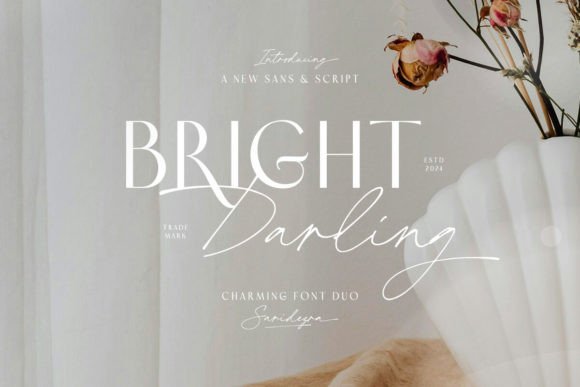
Bright Darling Duo: The Font Pairing That Balances Polish and Personality
There's a particular kind of design challenge that comes up constantly: you need something that looks refined and professional, but not cold. You want warmth and character, but not at the expense of clarity. It's the reason so many of us spend hours scrolling through font libraries, testing combinations, and second-guessing our choices. The Bright Darling Duo arrives as a direct answer to that tension—a thoughtfully crafted pairing of a clean sans-serif and an elegant script typeface that work together without competing for attention.
What Makes This Font Pairing Work So Well
The genius of Bright Darling Duo lies in its restraint. The sans-serif component carries the weight of modern minimalism—geometric enough to feel current, but with subtle curves that keep it from feeling sterile. It's the kind of sans serif font you'd see anchoring a luxury skincare label or the navigation bar of a boutique hotel's website. It does its job quietly and does it well.
The script counterpart, meanwhile, introduces something entirely different. It has the fluidity of genuine handwriting without the sloppiness that plagues so many script font options. There's a confidence in its strokes—each letter connects naturally to the next, creating that handcrafted feel that so many brands are chasing right now. Think of the difference between a mass-produced greeting card and one where someone actually took the time to write something beautiful. That's the energy this handwritten font brings to the table.
Together, these two styles create a visual conversation. The sans-serif provides structure. The script provides soul. When you pair them on a single layout, you get a font pairing that feels intentional rather than accidental—and that kind of intentionality is exactly what separates amateur design from professional work.
Where This Font Duo Truly Shines
Let's talk about real projects. If you're building a brand identity from scratch, this pairing gives you a built-in system. Use the sans-serif for your primary logo text, body copy, and functional elements like buttons and navigation. Then bring in the script for accent headlines, taglines, or that one hero phrase on your homepage that needs to stop someone mid-scroll. You've just created visual hierarchy without needing a design degree.
Packaging design is another space where this duo excels. Imagine a candle label where the product name flows in graceful script while the scent description and weight information sit neatly below in the sans-serif. Or a bakery's box where "Made with Love" curves gently above a clean ingredient list. The contrast between the two styles creates an emotional layering that single-font designs struggle to achieve.
For social media graphics, the pairing solves a persistent problem: how do you create posts that look polished but still feel personal? The script font handles quotes, announcements, and callouts with personality, while the sans-serif keeps supporting text readable at small sizes. This balance matters especially on platforms like Instagram and Pinterest, where visual appeal directly impacts engagement.
Editorial design benefits enormously from this kind of thoughtful font pairing. Magazine spreads, lookbooks, and digital publications can use the script for pull quotes and section dividers while the sans-serif handles captions and body text. The result feels cohesive without being monotonous—exactly the kind of reading experience that keeps people turning pages.
Wedding invitations, event programs, and stationery projects are natural fits as well. The script brings that celebratory, personal touch that clients expect, while the sans-serif ensures practical details like dates, addresses, and RSVP information remain perfectly legible. It's a combination that looks expensive without requiring a custom calligrapher.
Practical Advice for Getting the Most Out of Your Typography
Choosing a premium font is only the first step. How you use it determines whether your design feels cohesive or chaotic. Here are some real-world observations worth considering:
Start with your project's emotional goal. Before you touch a single letter, ask yourself what feeling you want to evoke. If you're designing for a wellness brand, the script's softness might dominate. If you're working on a tech startup's landing page, the sans-serif should carry most of the load with the script appearing only in carefully chosen moments. The same display font can tell completely different stories depending on how heavily you lean on each style.
Test your pairings at actual sizes. A script font that looks gorgeous at 72 points on your monitor might become illegible at 14 points on a business card. Print a test sheet. View it on your phone. Ask someone else to read it from three feet away. Readability considerations aren't optional—they're the foundation of effective visual communication.
Don't overuse the script. This is probably the most common mistake with any script font. When every headline, subhead, and call-to-action is rendered in flowing cursive, the effect becomes exhausting rather than elegant. Treat the script like a spice—essential for flavor, but overwhelming in large quantities. A good rule of thumb: if more than 20% of your visible text is in script, consider pulling back.
Review all included font styles carefully. Quality font duos like this one typically include multiple weights, alternates, and stylistic variations. Spend time exploring what's available before settling on a default approach. You might discover that a specific alternate letterform in the script solves a kerning problem you didn't even know you had, or that a lighter weight of the sans-serif works better for body copy than the regular version.
Consider your commercial licensing needs. If you're creating designs for clients, selling merchandise, or distributing digital products, make sure your license covers those uses. This isn't the exciting part of choosing a creative font, but it protects both you and your clients from legal headaches down the road. Most reputable design assets come with clear licensing terms—read them before you start designing.
Beyond the Basics: Building Visual Consistency Across Platforms
One of the most underappreciated benefits of a well-constructed font pairing is how it simplifies cross-platform consistency. When your website, printed materials, social media presence, and marketing assets all draw from the same typographic system, your audience starts recognizing your brand before they even read a word. That recognition compounds over time into genuine trust.
Think about the brands you personally gravitate toward. Chances are, their typography is consistent enough that you could identify a piece of their content from across a room. That's not an accident—it's the result of choosing the right tools and using them with discipline.
Modern typography gives us more options than ever, which is both a gift and a trap. It's easy to chase novelty, downloading a new typeface for every project. But there's real power in committing to a system like Bright Darling Duo and learning to use it well across different contexts. The sans-serif adapts to web design and digital products with ease. The script elevates logo design and print materials without feeling gimmicky. Together, they cover an enormous range of applications while maintaining a unified aesthetic.
The best typography decisions aren't about finding the most beautiful font. They're about finding the right combination of beauty, function, and versatility for the work you actually do. For designers, entrepreneurs, and creators who need that balance of sophistication and warmth—who want their work to feel both polished and genuinely human—a pairing like this one quietly solves a problem that used to take hours of trial and error to address.